


HDPE Pipe Reducing Tee Fitting
Description
Technical Parameters
We strengthen the consciousness of fine products, carry forward the spirit of craftsmanship, and strive to create high-quality benchmark Electrofusion End Cap, coupling hdpe pipe, HDPE WYE Tee. We have reasonable price and automatic production in batch, which greatly reduces the labor cost. We maintain and continuously optimize the positive interaction with customers and the external environment. 'Continuous pursuit of customer satisfaction, contribute to social development and human progress' is our business purpose and philosophy.
HDPE Electrofusion Fittings, HDPE Electrofusion Reducing Tee, Electrofusion reducing Tee,Electrofusion tee reducer
HDPE electrofusion reducing tee is used to tee off a HDPE pipe, to add in a smaller size outlet to a PE pipe. Electrofusion reducing tees are often used to supply water or gas to an area from a main pipeline, as they have a smaller off-take (and therefore less flow) than the original pipeline.
Electrofusion reducing tee fittings may also be known as an electrofusion tee reducer or EF reducing tee. It has implanted metal coils placed around two ends of outlets, and the other branch outlet are spigot type, and requires a coupler to join it to another pipe or fittings.
Made by 100% PE100 material, SUNPLAST HDPE reducing tee electrofusion can can be supplied in a diameter sizing from dn32~dn400mm in SDR11-PN16. SDR 11 electrofusion tee reducer fittings are rated to PN16 for water and PN10 for gas.
The electrofusion reducing tee fittings are injection molded in one time, and conform to ISO4427-3,EN12201-3, AS/NZS 4129, EN1555, EN ISO15494 standard (ISO4437-3 for gas)
SUNPLAST keeps mass stock in demand for regular sizes, and customers’ urgent demand & prompt shipment request can be satisfied.
More brief details as below:
Product | HDPE Electrofusion Reducing Tee, Electrofusion reducing Tee,Electrofusion tee reducer |
Specification | DN32~DN400mm |
SDR/pressure ratings | SDR11-PN16 |
Material | Virgin PE100 material |
Manufacturing Process | Injection molded |
Color | Regular stock in black, blue/yellow available if quantity is big |
Manufacturing Standard | ISO4427-3,EN12201-3, AS/NZS 4129, EN1555, EN ISO15494 (ISO4437-3 for gas) |
Product Specifications
HDPE Electrofusion Reducing Tee: available from DN32×20~DN400×315mm
Pressure: SDR11-PN16 & SDR17-PN10
Material: 100% virgin PE100 material
Color: black color or blue color.


ΦD×ΦD1 | L | A | B | Φd | SDR17 | SDR11 |
32×20 | 118 | 45 | 48 | 4.0/4.7 | × | √ |
32×25 | 118 | 45 | 48 | 4.0/4.7 | × | √ |
50×25 | 147 | 51 | 54 | 4.0/4.7 | × | √ |
50×32 | 147 | 51 | 54 | 4.0/4.7 | × | √ |
50×40 | 147 | 52 | 56 | 4.0/4.7 | × | √ |
63×25 | 168 | 57 | 49 | 4.0/4.7 | × | √ |
63×32 | 168 | 57 | 56 | 4.0/4.7 | × | √ |
63×40 | 168 | 57 | 56 | 4.0/4.7 | × | √ |
63×50 | 168 | 57 | 64 | 4.0/4.7 | × | √ |
75×32 | 186 | 62 | 56 | 4.0/4.7 | × | √ |
75×40 | 186 | 62 | 56 | 4.0/4.7 | × | √ |
75×50 | 186 | 62 | 63 | 4.0/4.7 | × | √ |
75×63 | 186 | 62 | 63 | 4.0/4.7 | × | √ |
90×50 | 210 | 66 | 64 | 4.0/4.7 | × | √ |
90×63 | 210 | 66 | 63 | 4.0/4.7 | × | √ |
90×75 | 210 | 67 | 80 | 4.0/4.7 | × | √ |
110×50 | 215 | 73 | 85 | 4.0/4.7 | × | √ |
110×63 | 215 | 74 | 69 | 4.0/4.7 | × | √ |
110×75 | 215 | 75 | 77 | 4.0/4.7 | × | √ |
110×90 | 238 | 73 | 85 | 4.0/4.7 | × | √ |
125×50 | 239 | 77 | 79 | 4.0/4.7 | × | √ |
125×63 | 239 | 77 | 79 | 4.0/4.7 | × | √ |
125×75 | 239 | 77 | 83 | 4.0/4.7 | × | √ |
125×90 | 239 | 77 | 87 | 4.0/4.7 | × | √ |
125×110 | 256 | 75 | 87 | 4.0/4.7 | × | √ |
160×50 | 248 | 86 | 78 | 4.0/4.7 | × | √ |
160×63 | 248 | 86 | 78 | 4.0/4.7 | × | √ |
160×75 | 248 | 86 | 83 | 4.0/4.7 | × | √ |
160×90 | 250 | 86 | 87 | 4.0/4.7 | × | √ |
160×110 | 305 | 86 | 87 | 4.0/4.7 | × | √ |
160×125 | 307 | 86 | 91 | 4.0/4.7 | × | √ |
200×50 | 297 | 95 | 70 | 4.0/4.7 | × | √ |
200×63 | 297 | 95 | 74 | 4.0/4.7 | × | √ |
200×75 | 297 | 95 | 79 | 4.0/4.7 | × | √ |
200×90 | 297 | 95 | 85 | 4.0/4.7 | × | √ |
200×110 | 365 | 96 | 87 | 4.0/4.7 | × | √ |
200×160 | 366 | 96 | 95 | 4.0/4.7 | × | √ |
225×90 | 400 | 111 | 86 | 4.0/4.7 | × | √ |
225×110 | 400 | 110 | 96 | 4.0/4.7 | × | √ |
225×160 | 400 | 110 | 105 | 4.0/4.7 | × | √ |
225×200 | 400 | 110 | 110 | 4.0/4.7 | × | √ |
250×110 | 431 | 113 | 97 | 4.0/4.7 | × | √ |
250×160 | 432 | 113 | 112 | 4.0/4.7 | × | √ |
250×200 | 433 | 113 | 116 | 4.0/4.7 | × | √ |
315×90 | 511 | 115 | 87 | 4.0/4.7 | × | √ |
315×110 | 511 | 115 | 90 | 4.0/4.7 | × | √ |
315×160 | 511 | 115 | 109 | 4.0/4.7 | × | √ |
315×200 | 511 | 115 | 117 | 4.0/4.7 | × | √ |
315×250 | 511 | 115 | 126 | 4.0/4.7 | × | √ |
400×110 | 620 | 125 | 115 | 4.0/4.7 | × | √ |
400×125 | 620 | 125 | 115 | 4.0/4.7 | × | √ |
400×160 | 620 | 125 | 115 | 4.0/4.7 | × | √ |
400×200 | 620 | 125 | 115 | 4.0/4.7 | × | √ |
400×250 | 620 | 125 | 115 | 4.0/4.7 | × | √ |
400×315 | 620 | 125 | 115 | 4.0/4.7 | × | √ |
(Noted: the technical data is just for reference, some data may change, if you need exact data, then please contact us directly)
Our Product Range
As a integrated & experienced manufacturer & provider in China, SUNPLAST can supply HDPE electrofusion fittings in a diameter sizing from dn25mm to dn630mm. SUNPLAST HDPE electrofusion fittings include: HDPE electrofusion coupler, HDPE electrofusion reducer, HDPE electrofusion tee, HDPE electrofusion elbow 90 degree, HDPE electrofusion elbow 45 degree, HDPE electrofusion flange, HDPE electrofusion saddles.,etc
Here in SUNPLAST, all customers can find the best solution of fittings for their pipeline systems.

Electrofusion procedure For HDPE Electrofusion Fittings
Electrofusion Fittings contain electrical filament wires which, when correctly connected to an
appropriate power source for the specified period of time, will fuse the coupling onto the pipe.
Tooling required for the welding of an electrofusion fitting is a suitable electrofusion control box with power supply and a scraper capable of removing 0.2-0.4mm from the
outside of the polyethylene pipe.
An alignment clamp should be used to ensure that the joint’s movement is kept to a minimum during the heating and cooling cycle together, with cleaning cloths and an indelible pen. A welding shelter should also be used to provide protection of the welding area against adverse weather conditions and
contamination.
The major procedure of butt welding including 4 steps:
1). Clean the pipe and cut ends squarely.
The pipe ends must be cut square and even by rotational pipe cutter, re-rounding the pipe edage if needed. Using cleaning cloths firstly clean the area of the pipe to be welded of any surface debris.
2). Mark Stab depth on the pipe
Without removing the sealed packaging mark on the pipe the area which is to be scraped, ie approximately 15-20mm beyond the insertion depth of the E/F coupler.
3). Scraping or peeling the outer surface of pipe edge.
Using a suitable pipe surface preparation tool“scraper” remove the pipe surface in the
selected area to a depth of 0.2-0.4mm; it is imperative at this stage of the operation that this is preformed correctly.
Wherever possible a mechanical end preparation tool is the preferred method of pipe surface preparation as it is capable of removing a continuous, even layer from the pipe surface.
4). Clean with suitable degreasing agent
Using degreasing agent to clean the scrap area, make sure no chippings or dirt on it
5). Stab E/F fittings completely into the HDPE pipe
Open the sealed bag containing the electrofusion fitting and slide it on to the pipe. The electrofusion coupler is fitted with a centre stop. Slide the fitting along the pipe until it comes into contact with the centre stop. Mark the insertion depth using an indelible marker pen.
6). Align & clamp the pipe
Correctly position and fit the restraining clamp to the assembly.
Clamps should always be used to secure an electrofusion assembly during the fusion cycle.
7). Fusion the joint
Input the fusion time either by using the information embossed on the coupler or by using the bar code affixed to the fitting. The method used will depend on the type of control box being used.
Once the coupler has completed the fusion cycle check that the melt indicators/melt wells show a successful fusion cycle has taken place. Melt wells, as shown above, should fill with melt to a point
approximately flush to the surface of the fitting. The melt indicators fitted to predominantly smaller fittings will rise beyond the body of the electrofusion fitting.
8). Cooling Time
Any handling, stresses or movement of the assembled pipe and/or fitting during the the cooling time may result in a reduced joint performance.
Only after completion of the cooling time mentioned on the fitting can the clamping tools and all other surrounding equipment may be dismantled.

Manufacturing Facilities
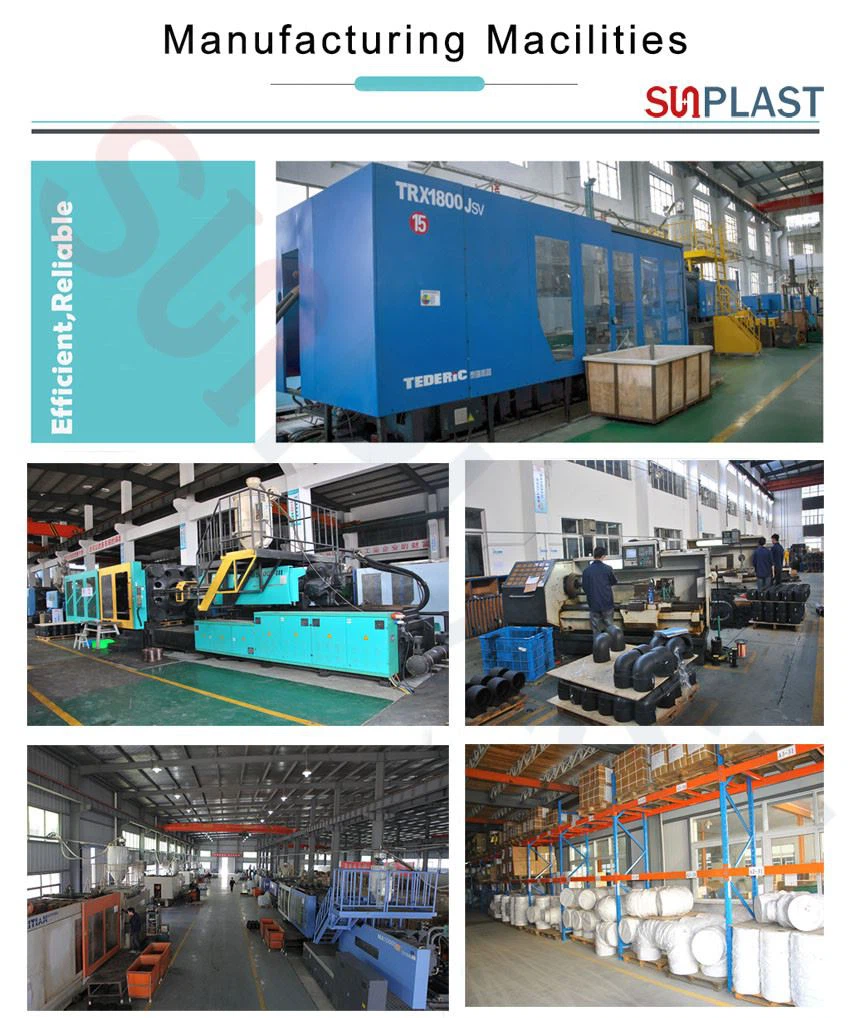
SUNPLAST is a ISO9001 certificated manufacturing factory. As a premier manufacturer of HDPE electrofusion fittings, the factory owns mature technology, advanced production machine, professional workers & completed QC system. All electrofusion fittings are manufactured strictly in compliance with national standards and international standards.
Till now, there is over 30 sets of injection machines in SUNPLAST workshop, available to manufacture HDPE fittings till 800mm, and annual production capacity reaches 6,000 tons.
FAQS

*What’s electrofusion?
A: A resistive implant form of welding technique that is increasingly becoming popular is electrofusion welding. It is widely used to join together polyethylene pipes and pipe fittings, as well as pipes made of polypropylene material. By the word electrofusion, it can be understood that this welding technique uses electric current to form and strengthen pipeline joints.
In particular, metal coils are implanted on both ends of the pipes, and these coils are melted through resistive heating that comes from the current being passed through them. When the melted portion of the pipe fitting becomes solid, the two pipes are effectively and strongly joined.
* Can HDPE electrofusion coupler be used for welding the PPR pipe?
A: No, HDPE electrofusion coupler is manufactured & designed to weld to the HDPE pipeline only, NOT suitable for PPR pipe.
* Is scraping necessary before Electrofusion?
A: Yes, before electrofusion, the installer shall scrap the oxidation layer on both edage of HDPE pipe, the scrap area shall cover the edage of pipe to the marking line on the pipe, which mark insert depth of the electrofusion fittings. This is necessary step.
*How long will an electrofustion joint last?
A: If the pipe has been prepared in accordance with guidelines and the jointing process has been carried out correctly, by a competent installer, the HDPE electrofusion fitting is expected to last as long as the lifetime of the pipe system and a minimum of 50 years.
Contact Us
If you have any requirements on HDPE Electrofusion fittings, or any question on our fittings, please contact us freely. SUNPLAST has well trained staff who are available to address your needs and provide technical support to all sectors when needed.

We are committed to integrating in-depth industry resources and advanced platform technology to rationalize the allocation of resources for the HDPE Pipe Reducing Tee Fitting industry. We adhere to the quality policy of survival by quality, development by science and technology, benefit by management and reputation by service, and establish a sound cost control system. Our company advocates the market cooperation principle of 'no harm to others and common development' and the survival competition principle of 'not belittling peers and self surpassing'.
Hot Tags: HDPE electrofusion reducing tee, China, suppliers, manufacturers, factory, buy, price, made in China, UPVC Faucet WYE Tee, HDPE Butt Fusion Cross, Compression reducing Tee fittings, uPVC Faucet Lateral Cross, hdpe elbow, uPVC Solvent Male Adaptor
Send Inquiry
You Might Also Like


